
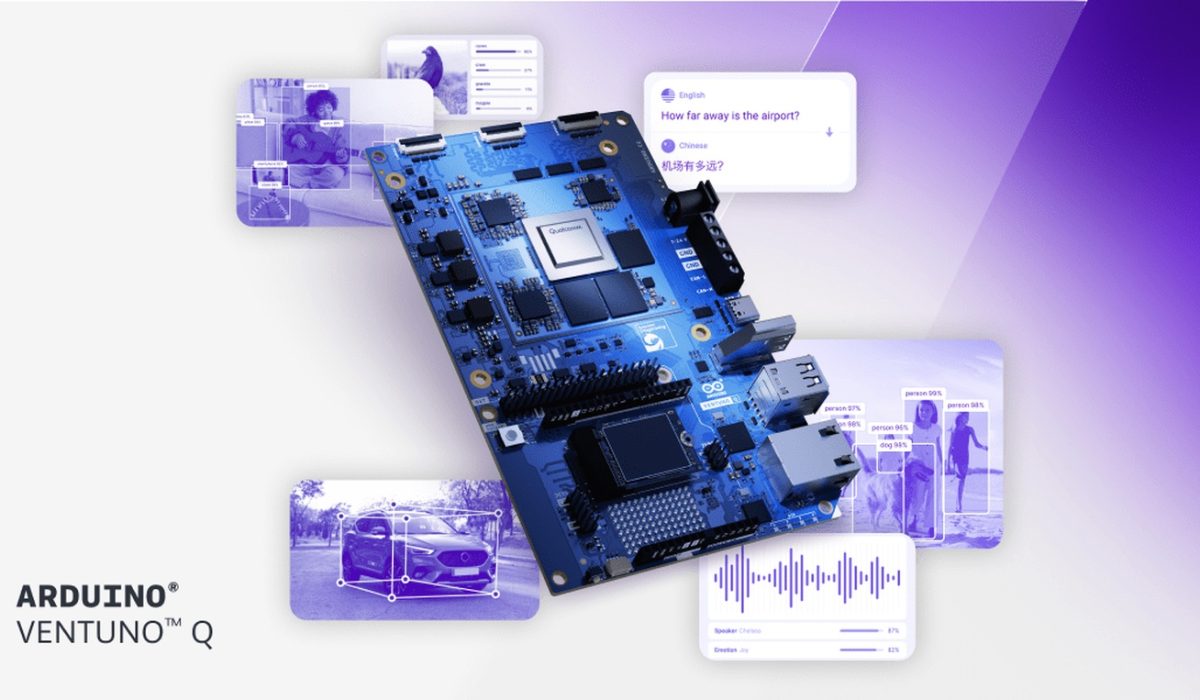
Qualcomm and Arduino have introduced the Arduino Ventuno Q, a new single-board computer that integrates advanced AI technology specifically for robotics and edge computing applications. This device is designed to bridge AI capabilities with precise physical-world interaction.
Hardware Specifications and Performance
The Arduino Ventuno Q is powered by Qualcomm’s Dragonwing IQ8 processor, which includes an 8-core ARM Cortex CPU, an Adreno ARM Cortex A623 GPU, and a Hexagon Tensor NPU delivering up to 40 TOPs (trillions of operations per second). This powerful combination supports complex AI workloads efficiently at the edge.
Complementing the processor, the board offers 16GB of LPDDR5 RAM and 64GB of onboard eMMC storage, expandable via an M.2 NVMe Gen4 slot. Connectivity options include Wi-Fi 6, Bluetooth 5.3, 2.5Gbps Ethernet, and USB camera support, making it versatile for robotics and AI-driven vision applications.
AI Capabilities and Pre-Trained Models
The Ventuno Q comes equipped with Arduino App Lab, featuring pre-trained AI models that cover large language models (LLMs), vision-language models (VLMs), automatic speech recognition (ASR), gesture recognition, pose estimation, and object tracking. These models are designed to operate fully offline, enabling AI deployment without reliance on cloud connectivity.
This offline capability is aimed at enabling AI-infused devices such as smart kiosks, healthcare assistants, traffic analysis systems, and edge AI vision and sensing applications that demand low latency and reliable operation in real-world environments.
Robotics and Edge AI Integration
Designed with robotics in mind, the Ventuno Q supports a comprehensive robotics software stack. It combines vision processing with deterministic motor control, enabling precision in movement and manipulation tasks. This makes it suitable for applications requiring simultaneous sensing and physical interaction.
This integration empowers robotics developers to prototype and deploy intelligent machines that can perceive, decide, and act autonomously on a single compact platform, potentially accelerating innovation in robotics and automation sectors.
Educational and Research Applications
Arduino highlights the Ventuno Q’s suitability for education and research, positioning it as a tool for exploring computer vision, generative AI, and real-time AI prototyping at the edge. It offers an accessible platform for educators and researchers to experiment with advanced robotics and AI technologies in practical settings.
Its ease of use, coupled with powerful hardware and pre-loaded AI models, supports hands-on learning and research in emerging AI fields—enabling a broad range of users to innovate without extensive infrastructure requirements.
Availability and Pricing
The Arduino Ventuno Q will be available starting in the second quarter of 2026 through the Arduino Store and other retailers. It is expected to be priced under $300, making it a competitively priced option for developers and institutions looking to leverage edge AI and robotics capabilities.
Qualcomm’s vision with the Ventuno Q is to bring advanced AI-driven robotics from abstract cloud environments into tangible physical applications, extending AI accessibility to a wider audience of innovators and developers.