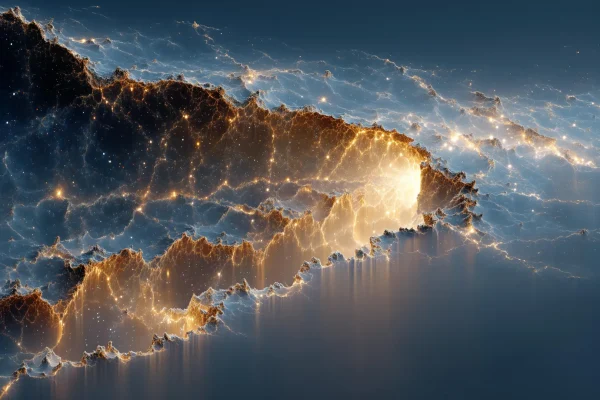
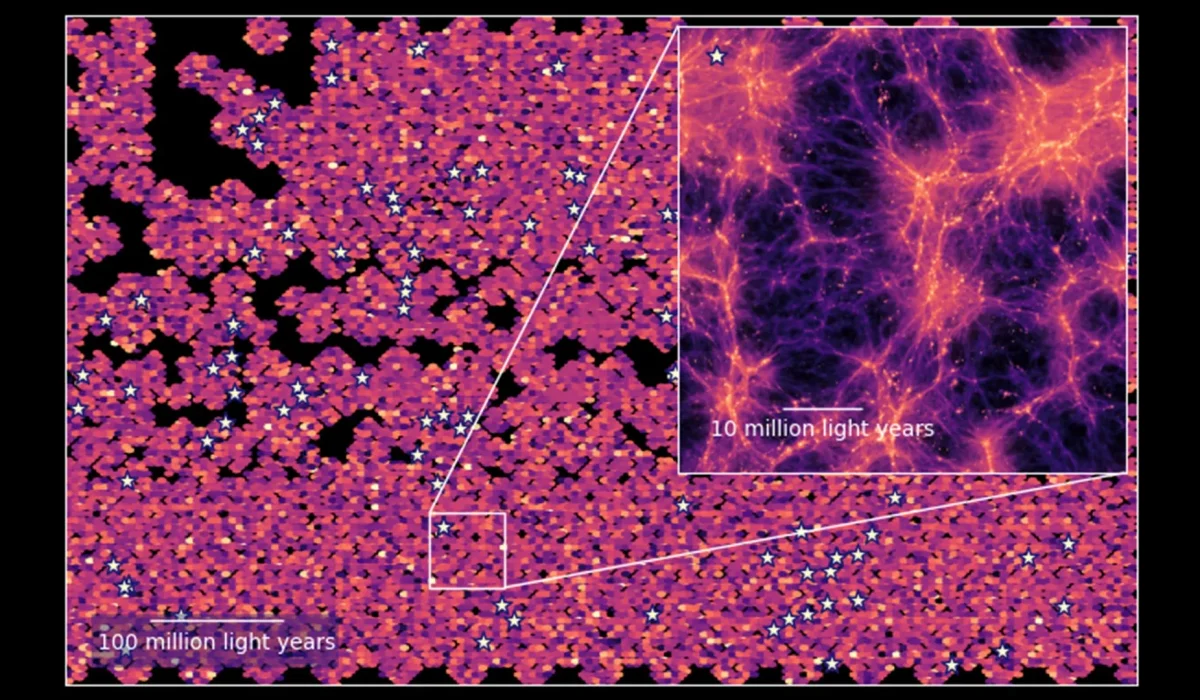
Astronomers have successfully developed the most extensive and detailed three-dimensional map of a luminous signal originating from the early universe. This groundbreaking achievement reveals previously hidden galaxies and vast cosmic gas structures from 9 to 11 billion years ago, offering new insights into cosmic evolution.
Mapping the Early Universe Using Lyman-Alpha Emissions
The research team utilized faint Lyman-alpha light generated by energized hydrogen atoms to trace the early cosmic landscape. This type of emission is critical in studying the universe’s formative periods, as it highlights both luminous galaxies and the diffuse gas present in intergalactic space.
By focusing on this glowing signal, scientists were able to visualize large-scale structures that traditional observation methods often miss, enabling a richer understanding of galaxy formation and distribution during an early cosmic era.
Application of Line Intensity Mapping Technique
The astronomers employed an advanced method known as line intensity mapping. Unlike traditional galaxy surveys that focus on individual bright objects, this technique captures the aggregate emission from all sources within a region, including faint and diffuse components.
This approach allowed the team to map not only the visible galaxies but also the surrounding gas that contributes significantly to the cosmic web. The data provides a comprehensive view of how matter was organized in the young universe.
Revelations About Hidden Galaxies and Cosmic Structures
The new 3D map revealed a multitude of galaxies that were previously undetectable with earlier technologies. These hidden galaxies contribute to the understanding of galaxy evolution and their role in the cosmic ecosystem.
Additionally, the mapping illustrated the filamentary structures formed by hydrogen gas, known as the cosmic web, which serves as the backbone for galaxy clusters and superclusters.
Implications for Understanding Cosmic Evolution
The detailed visualization of matter from this early epoch enables researchers to refine models of cosmic evolution. Understanding how galaxies and gas were distributed billions of years ago helps clarify the processes driving galaxy formation and the growth of cosmic structures.
This breakthrough has the potential to guide future observational campaigns and improve theoretical frameworks in cosmology, enhancing our grasp of the universe’s history and its large-scale composition.
Future Prospects and Technological Developments
Building on this success, astronomers plan to refine line intensity mapping techniques further to explore other epochs of the universe with greater precision. Advanced instruments and collaborations are expected to expand the scale and detail of such cosmic maps.
Ongoing and upcoming surveys will continue to probe the cosmic web and hidden galaxies, providing deeper insights and potentially new discoveries about the early universe’s structure and dynamics.