Researchers exploring Mars have potentially identified a previously unknown mineral within the planet’s ancient sulfate deposits. This discovery offers new insights into the geological processes that shaped Mars’ surface and its past environmental conditions.
Discovery of Ferric Hydroxysulfate on Mars
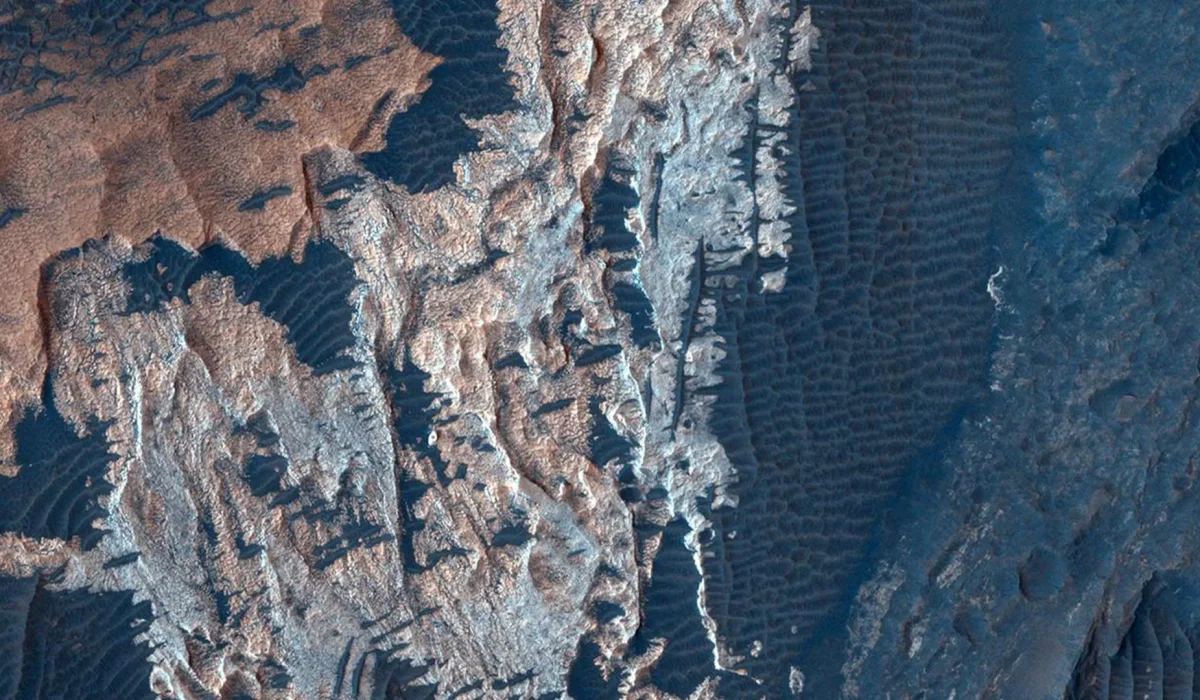
Scientists combined laboratory experiments with data from Mars orbiters to analyze sulfate deposits found near the Valles Marineris canyon system. Their findings revealed an unusual iron sulfate compound, ferric hydroxysulfate, which had not been observed before on Mars.
The identification of this mineral was made possible by replicating Martian conditions in laboratories and comparing the spectral signatures with those recorded by orbiters. This approach allowed for a precise match to the previously unexplained spectral data from the planet’s surface.
Formation Process Linked to Ancient Water Activity
The mineral likely formed in layered sulfate deposits that were originally left behind by ancient water bodies on Mars. The presence of these sulfates indicates that water once existed and played a significant role in the planet’s history.
Later volcanic or geothermal heating altered the chemistry of these deposits, causing the formation of ferric hydroxysulfate. This transformation points to a dynamic geologic environment on early Mars where water and heat interacted extensively.
Implications for Mars’ Geological History
The discovery of this new mineral adds to the understanding of the red planet’s aqueous history and volcanic activity. It suggests that areas surrounding Valles Marineris experienced complex chemical changes influenced by volcanism or geothermal phenomena.
Such findings help reconstruct the environmental conditions that existed on Mars billions of years ago, improving models of its climate evolution and potential habitability.
Future Exploration and Study
Ongoing missions and future rover explorations will aim to further investigate these sulfate deposits. Detailed in situ analysis could confirm the presence of ferric hydroxysulfate and clarify its role in Martian geology.
These studies will contribute to a more comprehensive understanding of Mars’ mineral diversity and geological processes, guiding future exploration efforts.