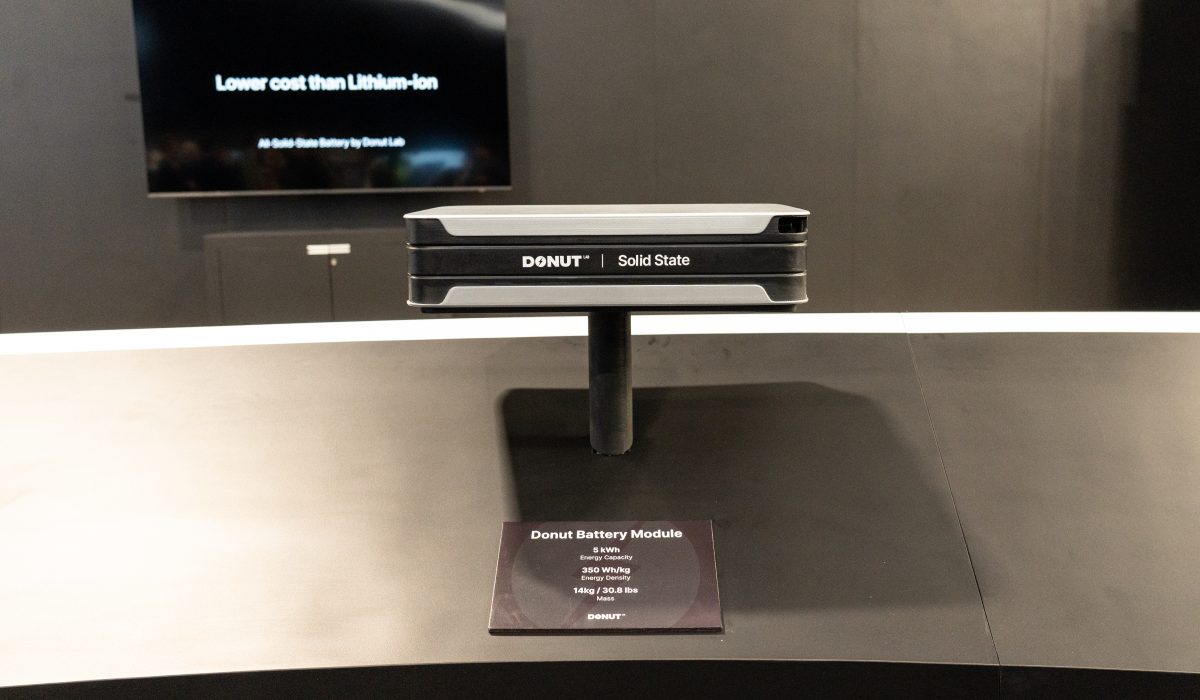
Finnish startup Donut Lab has recently addressed skepticism about its solid-state battery technology, clarifying that its device is not a supercapacitor despite similarities in charging speed. The company provided fresh test results to demonstrate that its battery operates differently from a supercapacitor, reinforcing its position in the developing solid-state battery market.
Clarifying the Technology Behind Donut Lab’s Battery
When Donut Lab first introduced its solid-state battery earlier this year, observers noted the battery’s ability to charge and discharge rapidly—traits often associated with supercapacitors, a distinct type of energy storage device. Supercapacitors store energy electrostatically and typically have faster charge-discharge cycles but lower energy density than batteries.
Donut Lab’s battery, on the other hand, relies on solid-state chemistry, which theoretically offers greater energy density and safety benefits compared to traditional lithium-ion batteries or supercapacitors. However, the overlap in fast charging led some to question the nature of Donut Lab’s prototype.
Results of the Latest Tests
To address these concerns, Donut Lab conducted a series of tests intended to distinguish its technology from supercapacitors. These tests examined characteristics such as energy retention, charge-discharge cycles, and voltage stability during operation.
The results showed that the battery maintains stable voltage over time and stores energy chemically rather than electrostatically, a key differentiator from supercapacitors. This confirms that the device delivers on the promise of a solid-state battery rather than simply mimicking a supercapacitor’s rapid charging traits.
Implications for the Electric Vehicle Market
If Donut Lab’s solid-state battery technology proves scalable, it could represent a significant advancement for electric vehicles (EVs). Solid-state batteries potentially offer higher energy density, faster charging times, and improved safety compared to conventional lithium-ion batteries.
Such improvements could lead to longer-range EVs with shorter charging stops, addressing two major consumer concerns. The market continues to seek breakthroughs in battery technology to accelerate the adoption of electric transportation.
Industry Reception and Next Steps
While the latest tests clarify the nature of Donut Lab’s technology, broader validation from independent third parties will be essential to gain widespread industry trust. Donut Lab remains engaged in further development and plans to pursue partnerships for scaling production.
The startup’s ability to commercialize its battery will depend on overcoming manufacturing challenges and proving long-term durability under real-world conditions. Continued transparency and data sharing may help address investor and consumer skepticism moving forward.