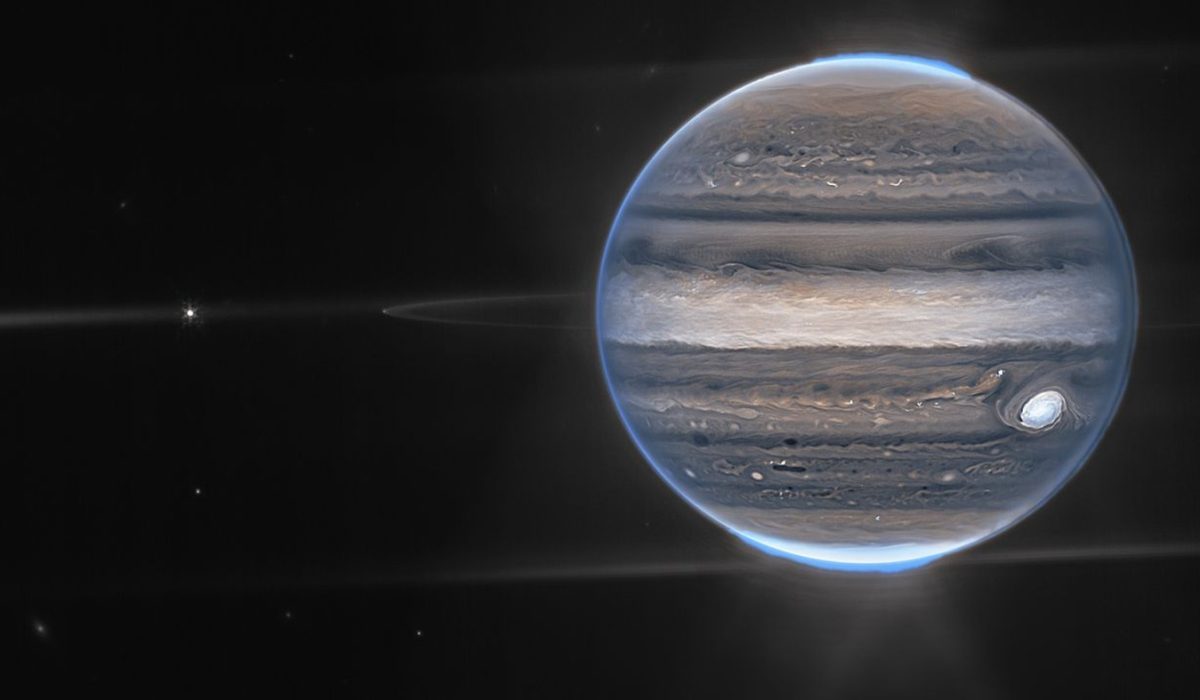
New data from the James Webb Space Telescope (JWST) has uncovered surprising details about the interaction between Jupiter’s moons and the planet’s auroras. These findings challenge prior understandings of the auroral processes and suggest a more intricate relationship than previously known.
Overview of Jupiter’s Auroras and Moons
Jupiter’s auroras, similar to Earth’s northern and southern lights, are caused by charged particles interacting with the planet’s magnetic field and atmosphere. However, Jupiter’s powerful magnetic environment and its multiple moons introduce unique phenomena. Scientists have focused on how the four largest moons—Io, Europa, Ganymede, and Callisto—influence these auroras by contributing charged particles.
Until now, the effect of these moons on auroral emissions was not fully understood, with models assuming more direct and uniform ionization processes. JWST’s advanced instruments have provided the first detailed temperature and ion density measurements in these regions.
New Findings on Temperature and Ion Density Variations
JWST observations revealed the presence of cold “footprints” in Jupiter’s auroras corresponding to the locations of its moons. These temperatures are significantly lower than expected, indicating that the moons create localized cooling effects in the ionized gas around Jupiter.
Additionally, ion densities at these footprints vary in complex patterns, challenging the notion that the moons simply increase ionization uniformly. This suggests dynamic interactions between magnetic fields, plasma flows, and the moons themselves.
Implications for Understanding Planet-Moon Magnetic Interactions
The discovery of cold footprints provides new insights into electromagnetic interactions in giant planet systems. It shows that moons can modulate auroral activity in ways that were previously underestimated, affecting the circulation and composition of plasma surrounding the planet.
This can lead to revising models for how planetary magnetic fields interact with embedded satellites and how energy is transferred within these systems, influencing not only Jupiter but potentially other gas giants in our solar system and beyond.
Role of JWST in Advancing Planetary Science
The James Webb Space Telescope, primarily known for its deep space observations, demonstrates its versatility by delivering cutting-edge data on planetary atmospheres and magnetospheres. Its infrared capabilities allow scientists to observe temperature and particle distributions with unprecedented precision.
This breakthrough highlights JWST’s growing role in solar system studies, complementing missions like Juno at Jupiter by providing context and detailed measurements from a unique vantage point.
Future Research Directions
The complex auroral footprints revealed by JWST open new questions about the underlying processes. Future studies may focus on temporal changes, magnetic field interactions, and the impact of other smaller moons on Jupiter’s magnetosphere.
Continued observations and combined data from telescopes and planetary missions will enhance understanding of magnetospheric physics and moon-planet interactions, shedding light on fundamental processes shaping giant planet environments.