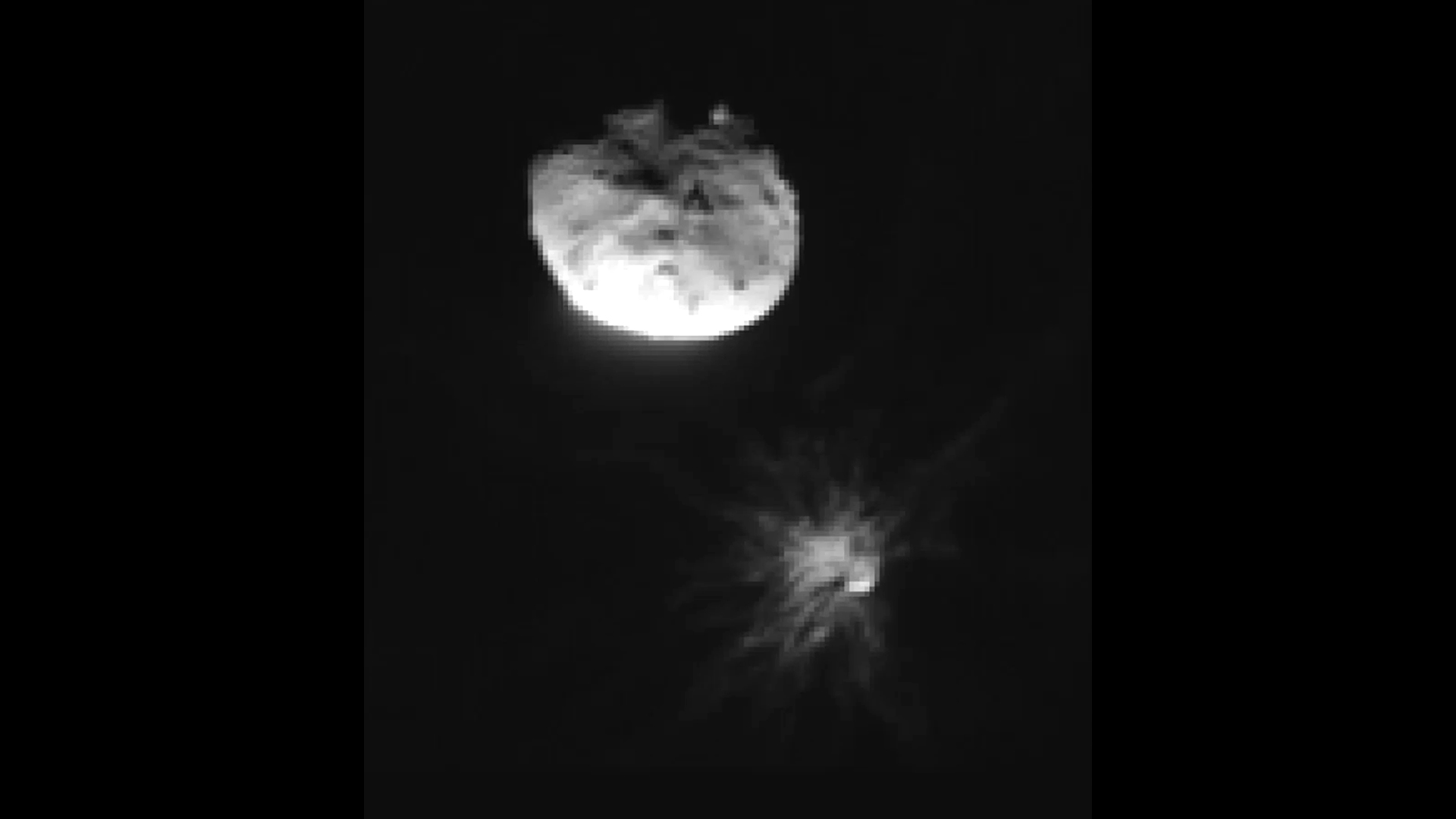
NASA’s DART (Double Asteroid Redirection Test) mission has demonstrated unexpected results beyond its initial target of altering the orbit of the asteroid moonlet Dimorphos. New research indicates that the impact also changed the trajectory of both Dimorphos and its larger companion, Didymos, as they orbit the Sun.
Overview of the DART Mission
The DART spacecraft was launched to test planetary defense techniques by intentionally crashing into Dimorphos, a small asteroid moonlet orbiting Didymos. The primary goal was to alter Dimorphos’s orbit around Didymos, demonstrating the feasibility of redirecting an asteroid’s trajectory.
In September 2022, DART successfully impacted Dimorphos, confirming its ability to modify orbital mechanics. This marked the first test of its kind directed at planetary defense, aiming to provide knowledge for future asteroid threat deflection.
Unexpected Shift in Orbit Around the Sun
Following new observations and analysis, scientists found that the impact did more than disrupt the orbit of Dimorphos around Didymos. The gravitational relationship between Dimorphos and Didymos is strong enough that the impact also altered their joint orbit around the Sun.
Such a shift in the heliocentric orbit was unforeseen, revealing the broader implications that kinetic impactor missions may have on asteroid system dynamics. Researchers are studying these effects to understand the complex gravitational interplay resulting from the deflection attempt.
Scientific Importance of Orbit Changes
These newly discovered orbital changes provide valuable data for modeling asteroid behavior and the potential consequences of deflection missions. Understanding how such impacts affect multi-body systems is crucial for refining future planetary defense strategies.
The findings also contribute to broader astronomy research regarding small-body interactions, orbital mechanics, and the evolution of binary asteroid systems. They help scientists simulate and predict the long-term effects of asteroid deflection with greater precision.
Next Steps in Planetary Defense Research
NASA and partner organizations are continuing to monitor the Didymos system to track the ongoing effects of the DART impact. This involves extensive follow-up observations using ground-based telescopes and space missions.
Future missions and studies will integrate these findings to enhance asteroid impact mitigation techniques, ensuring better preparedness for any potential Earth-bound asteroid threats.