
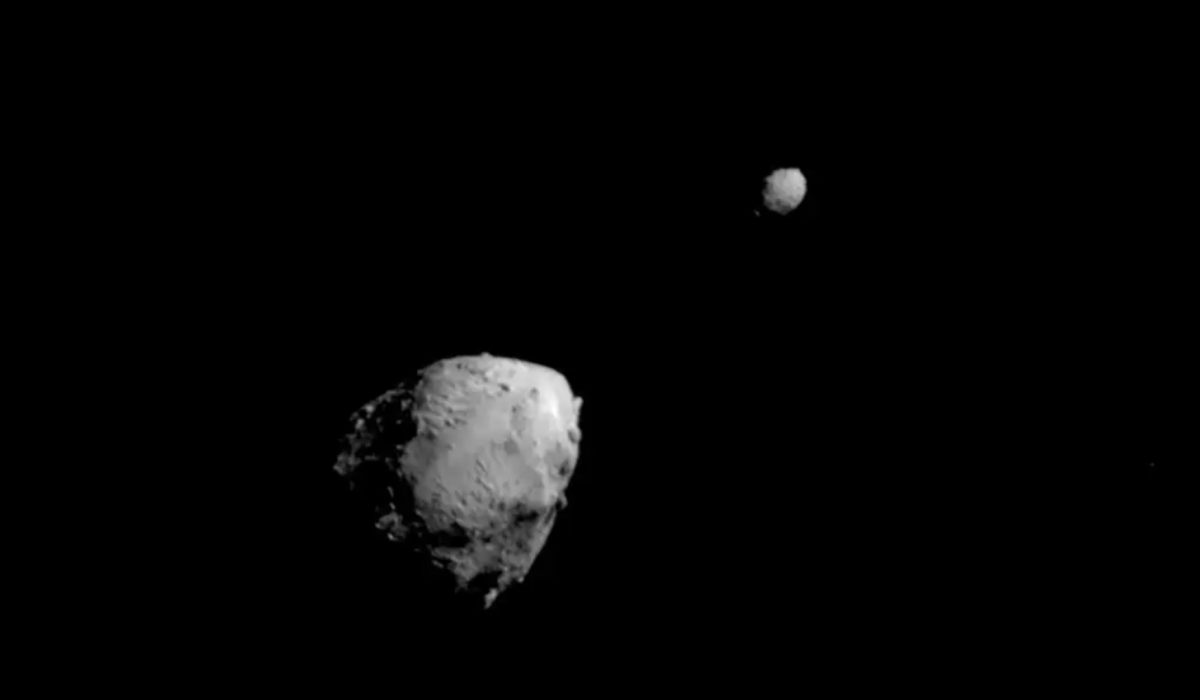
NASA’s Double Asteroid Redirection Test (DART) mission successfully changed the orbit of a binary asteroid system, marking a historic first where a human-made object has measurably altered the path of a celestial body around the Sun. This milestone offers promising insights for planetary defense strategies against potential hazardous asteroids.
Overview of the DART Mission
The DART mission was designed to test a method for deflecting potentially dangerous asteroids by intentionally crashing a spacecraft into one to alter its trajectory. Targeting the asteroid moonlet Dimorphos, which orbits the larger asteroid Didymos, the mission aimed to demonstrate how kinetic impact could serve as a viable planetary defense technique.
Dimorphos measures about 560 feet in diameter and posed no threat to Earth, making it an ideal candidate for testing without risk. The spacecraft’s collision with Dimorphos shortened its orbital period around Didymos, providing the initial confirmation that the deflection strategy was effective.
Changes Observed in Dimorphos’ Orbit
Following the impact, researchers reported that Dimorphos’ orbit around Didymos had been reduced by approximately 33 minutes. Its path was nudged about 120 feet closer to the larger asteroid, confirming a significant orbital shift resulting from the kinetic collision.
This alteration was considered a clear success for the mission objectives, demonstrating the feasibility of changing an asteroid’s movement through human intervention.
Impact on the Binary Asteroid System’s Solar Orbit
New research from NASA’s Jet Propulsion Laboratory revealed that the effects of the DART mission extended beyond the immediate binary system. The impact altered the entire Didymos-Dimorphos system’s orbit around the Sun, a change previously unrecorded by any human-made object.
The binary system, which completes an orbit around the Sun every 770 days, experienced a slight acceleration, changing its velocity by approximately 11.7 microns per second or about 1.7 inches per hour. While seemingly minute, this shift is crucial over longer timescales.
Implications for Planetary Defense
Rahil Makadia, lead author of the study, emphasized the significance of such a small orbital adjustment, noting that subtle changes accumulate over time and can determine whether an asteroid may strike or bypass Earth. This reinforces the potential of kinetic impactors as an effective method to avert future asteroid threats.
The DART mission sets a precedent for future efforts in asteroid deflection, providing valuable data and confidence in humanity’s ability to protect the planet through precise space interventions.
Future Prospects and Missions
NASA and international space agencies are planning further studies and missions to build on DART’s success. These upcoming endeavors will aim to refine impact techniques, study different asteroid properties, and develop robust strategies for planetary defense.
Overall, the outcomes of the DART mission mark a critical advancement in space research and planetary safety, showcasing the growing capabilities of human technology beyond Earth.