Physicists have long aimed to reconcile the principles of quantum mechanics with Einstein’s theory of gravity. A recent breakthrough from researchers at TU Wien suggests that particles may not exactly follow the classical paths, or geodesics, predicted by relativity when quantum effects of spacetime are considered.
Reevaluating Classical Paths in Relativity
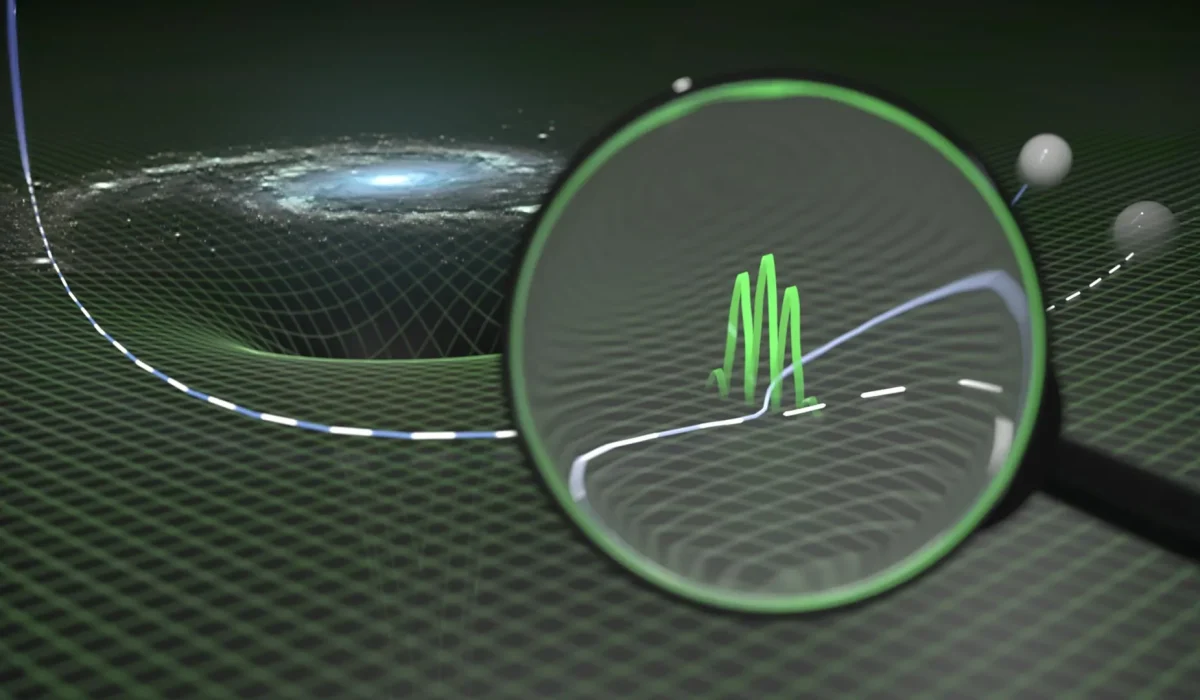
Einstein’s general relativity describes gravity as the curvature of spacetime, with particles traveling along geodesics—paths that represent the shortest distance in curved spacetime. These trajectories have formed a fundamental concept in understanding gravitational phenomena, from planetary orbits to black hole dynamics.
However, general relativity is a classical theory and does not account for the probabilistic nature of quantum mechanics, which governs the microscopic world of particles. The challenge has been to develop a framework that integrates these two pillars of physics.
Introducing the Quantum Geodesic Equation
The research team at TU Wien introduced a quantum analogue to classical geodesics, termed the “q-desic equation.” This new formulation modifies the classical paths by incorporating quantum properties of spacetime, acknowledging that spacetime itself may exhibit quantum fluctuations.
By applying this quantum geodesic framework, the researchers demonstrated that particles could experience slight deviations from the trajectories predicted by classical relativity when moving through a quantum-affected spacetime environment.
Implications for Quantum Gravity Theories
This development could provide essential insights into quantum gravity, an area that seeks a unified theory describing gravitational interactions at quantum scales. The q-desic equation offers a promising tool to investigate how particles behave under simultaneous quantum and gravitational influences.
Such work moves beyond purely theoretical models by suggesting observable consequences derived from quantum gravitational corrections, potentially guiding future experimental validations.
Potential Impact on Cosmology and Particle Physics
Understanding deviations from classical geodesics might influence interpretations of cosmic phenomena such as black holes, early universe conditions, and the behavior of high-energy particles in strong gravitational fields.
The results can also inform particle physics by indicating how fundamental particles might interact with the underlying quantum structure of spacetime, prompting new questions about the nature of reality at the smallest scales.
Future Directions and Challenges
While promising, the quantum geodesic approach requires further refinement and integration with existing quantum gravity models such as string theory or loop quantum gravity. Experimental detection of these predicted deviations remains a significant challenge due to the minuscule scales and energies involved.
Continued collaboration between theorists and experimentalists will be crucial to test these concepts and pave the way toward a comprehensive understanding of quantum gravity.