After years of debate, researchers have conclusively determined that the Silverpit Crater beneath the North Sea was formed by an asteroid impact approximately 43 to 46 million years ago. This discovery sheds new light on the geological history of the region and the catastrophic effects of the asteroid collision.
New Evidence from Seismic Imaging
Advancements in seismic imaging technology allowed scientists to create detailed maps of the Silverpit Crater’s structure. This imaging revealed distinctive impact-related features that matched those found in known asteroid craters on Earth. These data clarified uncertainties about the crater’s origin, firmly pointing to an extraterrestrial impact event rather than volcanic or tectonic causes.
The seismic profiles showed a clear depression with rim uplift consistent with impact craters. These characteristics, combined with other geological observations, helped researchers build a comprehensive case for the crater’s formation through an asteroid collision.
Shocked Minerals Provide Crucial Confirmation
In addition to seismic data, researchers obtained rare shocked minerals from rock samples retrieved near the crater site. These minerals exhibit microscopic structures that form only under the intense pressures and temperatures found in asteroid impacts. Their presence is considered definitive proof of an impact event.
The study of these shocked minerals not only confirmed the asteroid impact theory but also provided insights into the magnitude of the collision. Their unique characteristics helped estimate the size of the asteroid and the energy released during the impact.
Asteroid Characteristics and Impact Scale
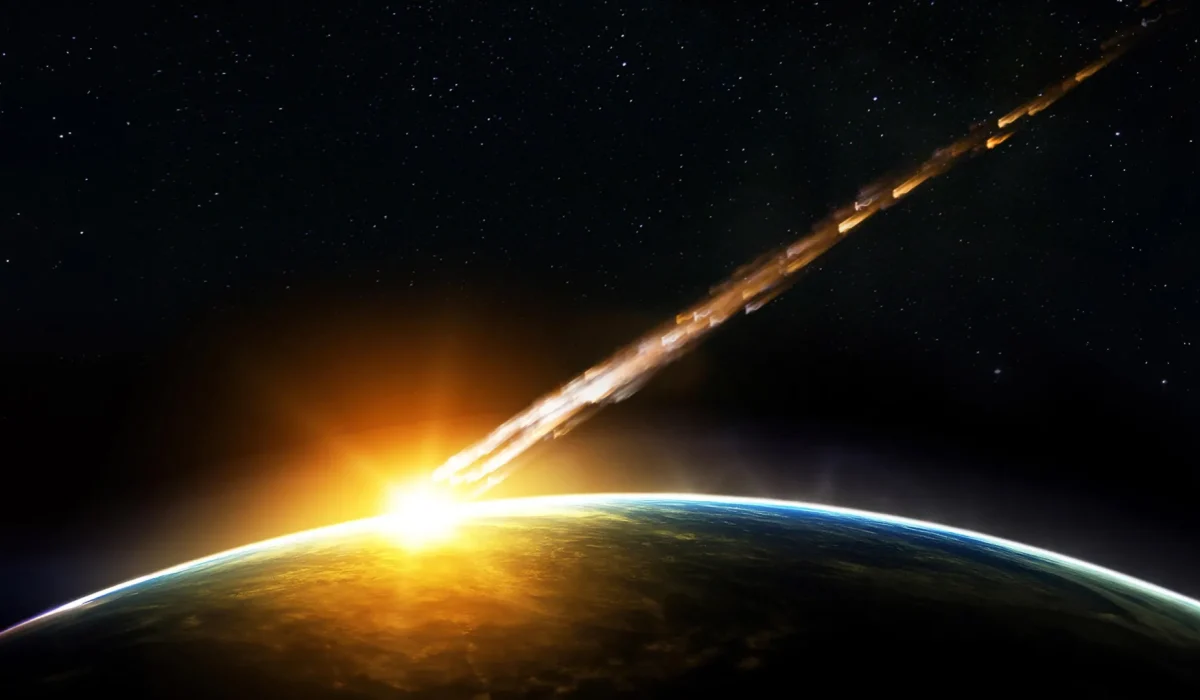
Researchers estimate that the asteroid responsible for the Silverpit Crater was about 160 meters in diameter. Although relatively small on a cosmic scale, this size was sufficient to cause major geological and environmental effects upon striking the seabed.
The force of the impact would have ejected a massive plume of debris several kilometers into the atmosphere and subjected the surrounding region to intense shock waves. This event, occurring in a marine environment, had unique consequences compared to terrestrial impacts.
Tsunami Generation and Its Potential Effects
One of the most significant outcomes of the Silverpit impact was the generation of a massive tsunami. Models suggest waves exceeding 100 meters (330 feet) in height were triggered, flooding coastal areas surrounding the North Sea basin.
Such a tsunami would have had devastating effects on marine and coastal ecosystems of the time. It may also have influenced sediment distribution and geological formations observed in subsequent layers beneath the seabed.
Implications for Geological and Environmental Studies
Confirming the origin of the Silverpit Crater as an asteroid impact improves understanding of the region’s geological history. It also offers valuable information on the frequency and scale of similar impacts during the Eocene epoch.
This research contributes to broader knowledge of impact-related phenomena and their long-term environmental consequences. It underscores the importance of multidisciplinary approaches combining geophysics and mineralogy to solve ancient geological mysteries.