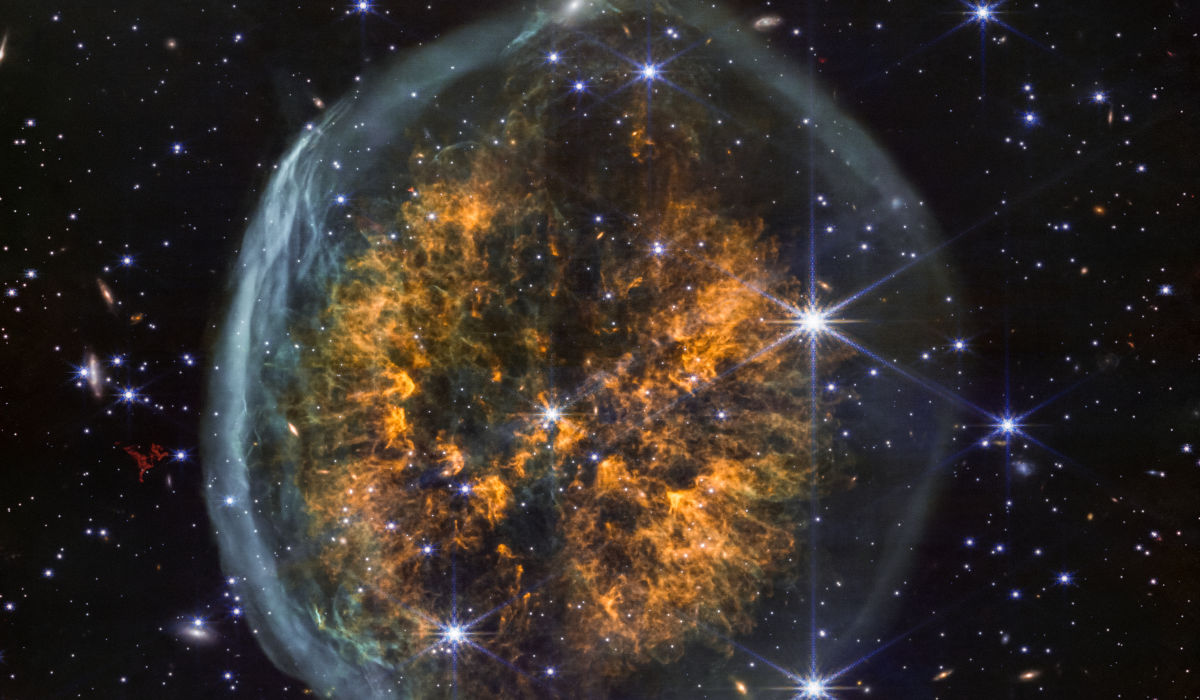
The James Webb Space Telescope has provided unprecedented images of PMR 1, a nebula famously nicknamed the “Exposed Cranium” due to its unique resemblance to a brain inside a transparent skull. This cloud of gas and dust offers new insights into stellar and cosmic structures through infrared observations.
Discovery and Nickname Origin
PMR 1, also known as the Cranium Nebula, was initially identified using infrared observations from NASA’s Spitzer Space Telescope before its retirement. Its peculiar shape, resembling the human brain encased in a transparent skull, made it a striking object of interest for astronomers and space enthusiasts alike.
This visually compelling form led to the informal nickname “Exposed Cranium,” emphasizing the nebula’s distinct structure. The nebula is an interstellar cloud composed of gas and dust, common in star-forming regions, but its unusual morphology is what sets it apart.
James Webb’s Infrared Imaging Capabilities
The Webb Telescope’s state-of-the-art instruments captured the Cranium Nebula in both near- and mid-infrared light, wavelengths not visible to the human eye. These infrared views reveal cooler and dust-obscured regions, allowing astronomers to study the nebula’s intricate details and composition.
Webb’s enhanced resolution and sensitivity provide a clearer understanding of how such nebulae evolve and the physical processes governing their shape. These discoveries contribute to the broader knowledge of star formation and the lifecycle of cosmic clouds.
Scientific Importance of PMR 1
Studying nebulae like PMR 1 enhances our understanding of the complex interactions between gas, dust, and stellar radiation. Such clouds are the birthplace of new stars, and their structures influence how stars and planetary systems develop.
The unusual form of the Cranium Nebula allows scientists to explore how varying density and radiation within the cloud can produce distinct shapes and features. This, in turn, informs models of nebular dynamics and star-forming environments.
Future Observations and Research Prospects
Continued observations by Webb and complementary telescopes are expected to reveal more about the chemical makeup and physical conditions inside PMR 1. Targeted spectroscopy and imaging will aid in mapping the distribution of elements and identifying young stars forming within the nebula.
These efforts will expand our knowledge of cosmic life cycles and enhance efforts to understand the complex environments in which solar systems like our own begin.